
Ellis Island History Timeline (1892–1954): Key Events, Facts & Immigration Story
Ellis Island is a very special place in the United States. It is in New York Harbor, close to the Statue of Liberty. This small island saw one of the biggest movements of people in history. Between 1892 and 1954, more than 12 million people came through Ellis Island. These people were tired from long journeys, but they were also full of hope. Many carried all their belongings in just one small bag. But Ellis Island was not always an immigration center. Its story started long before that. Over time, it has had many different uses.
It was once a place where Native Americans fished and hunted
Later, it became a trading place during colonial times
It was even used to hang pirates
Then it became a military storage area
Finally, it became a famous immigration station
Today, Ellis Island is known as a symbol of the American Dream. It represents hope, new beginnings, and a better future. If you plan to visit Ellis Island, take a Statue of Liberty tour, or learn about your family history, understanding this timeline will help you know why this place is so important.
Before 1000 AD: Who Lived on Ellis Island First
A very long time ago, even before the year 1000, Ellis Island was home to Native Americans called the Lenape people. They spoke a language called Algonquian and lived in this area for thousands of years.
The island was a great place for them because it was located in New York Harbor and had many natural resources. They used the island for fishing, collecting shellfish, and hunting small animals.
Another group called the Mohegan Indians gave the island the name Kioshk, which means Gull Island. This name showed what the island looked like in nature at that time.
Many years later, researchers studied the land and found more than 18,000 old items. These included pieces of pottery, tools, and shell remains. These discoveries show that people lived there and used the island’s resources for a very long time.
1630-1770s: Who Owned Ellis Island and What Was It Called Before
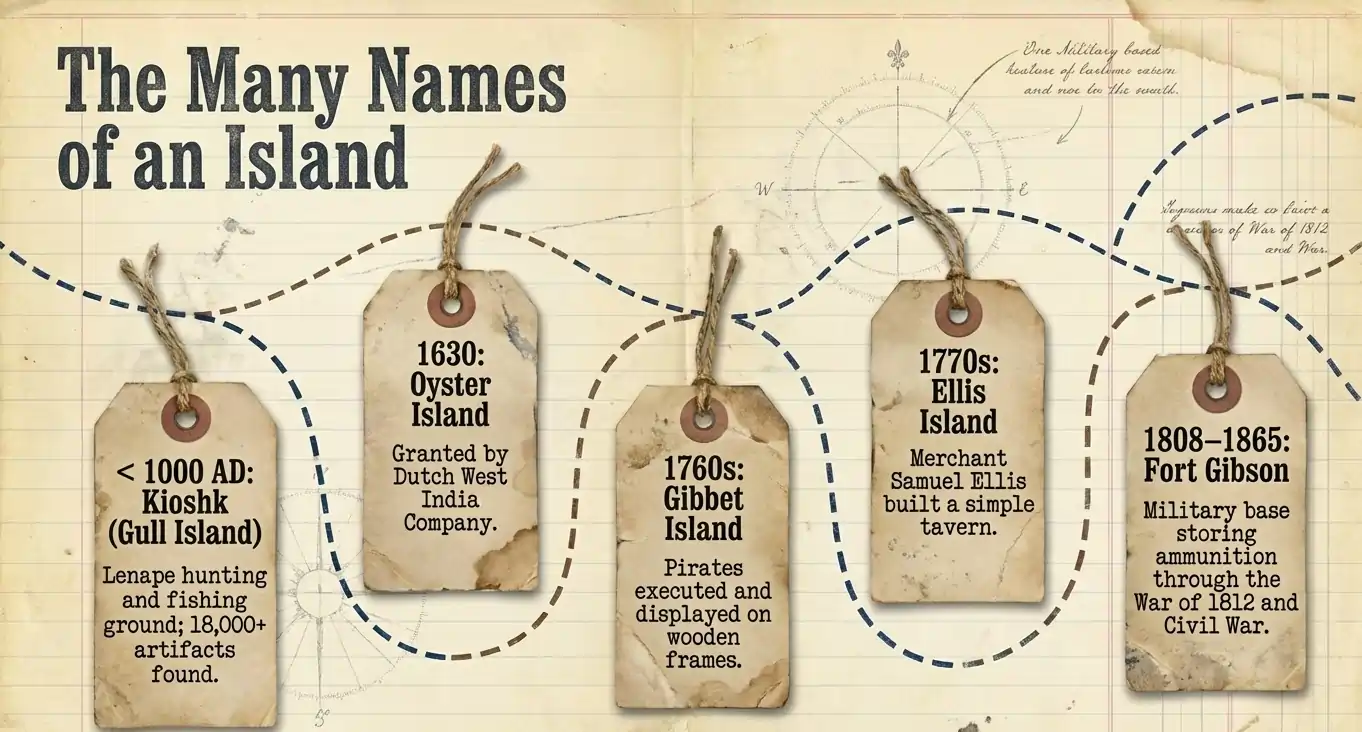
In the year 1630, a company called the Dutch West India Company gave the island to a man named Michael Paauw. He saw that there were many shellfish on the island, so he named it Oyster Island.
After some time, the island changed owners many times. In 1674, a man named Captain William Dyre owned the island. He renamed it Dyre’s Island.
Later, the island was given different names again, such as Bucking Island and Anderson’s Island. This shows that the island changed hands often and people kept giving it new names.
1760s: Why Ellis Island Was Called Gibbet Island?
In the 1760s, the island got a very dark and scary name. It was called Gibbet Island. This happened because pirates and criminals were punished there. They were publicly executed, and their bodies were displayed on wooden frames called gibbets.
This was done as a warning to ships entering the harbor. It showed everyone that breaking the law would lead to serious punishment.
1770s: How Ellis Island Got Its Name
In the 1770s, a merchant named Samuel Ellis bought the island. He built a small tavern there where people could come and relax.
Even though his business was simple, his name became very important. Over time, people started calling the island Ellis Island. This is how the island got the name we still use today.
1808-1865: How Ellis Island Was Used for the Army
In 1808, the United States government bought Ellis Island. They wanted to use it to help protect the country. The island was used for defense in many ways. The government built a fort called Fort Gibson on the island. This fort helped protect New York Harbor.
They also stored important and dangerous items there, like ammunition and gunpowder. Ellis Island was used during important wars, including the War of 1812 and the Civil War. During these times, it helped support the army and keep the area safe.
1865-1891: Where Immigrants Went Before Ellis Island
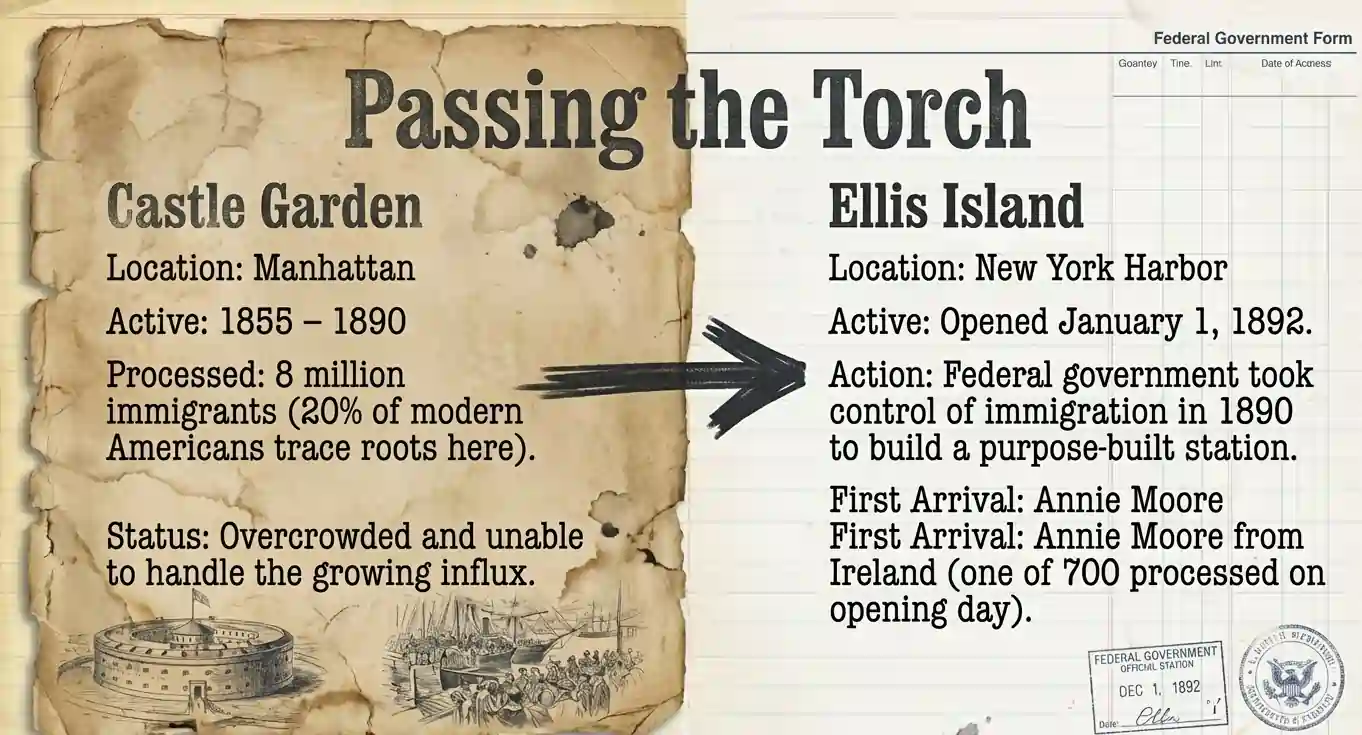
Before Ellis Island was used, immigrants went to a place called Castle Garden in Manhattan. Castle Garden worked as an immigration center from 1855 to 1890. During this time, about 8 million immigrants passed through it. Today, about 20 percent of Americans can trace their family history back to this place.
As more and more people came to the United States, Castle Garden became too crowded and could not handle everyone. Because of this, in 1890, the federal government took control of immigration. They then chose Ellis Island to build a new and better immigration station.
1892: When Ellis Island Opened and Who Came First
Ellis Island officially opened on January 1, 1892. The very first person to arrive was a girl named Annie Moore from Ireland. She became the first immigrant to be processed at Ellis Island.
On that first day, about 700 immigrants were checked and allowed to enter the country. By the end of the first year, around 450,000 immigrants had passed through Ellis Island.
What Happened to Immigrants at Ellis Island
For many people, coming to Ellis Island was both exciting and scary. They felt hope for a better life, but they were also worried about what would happen next.
How Immigrants Were Checked
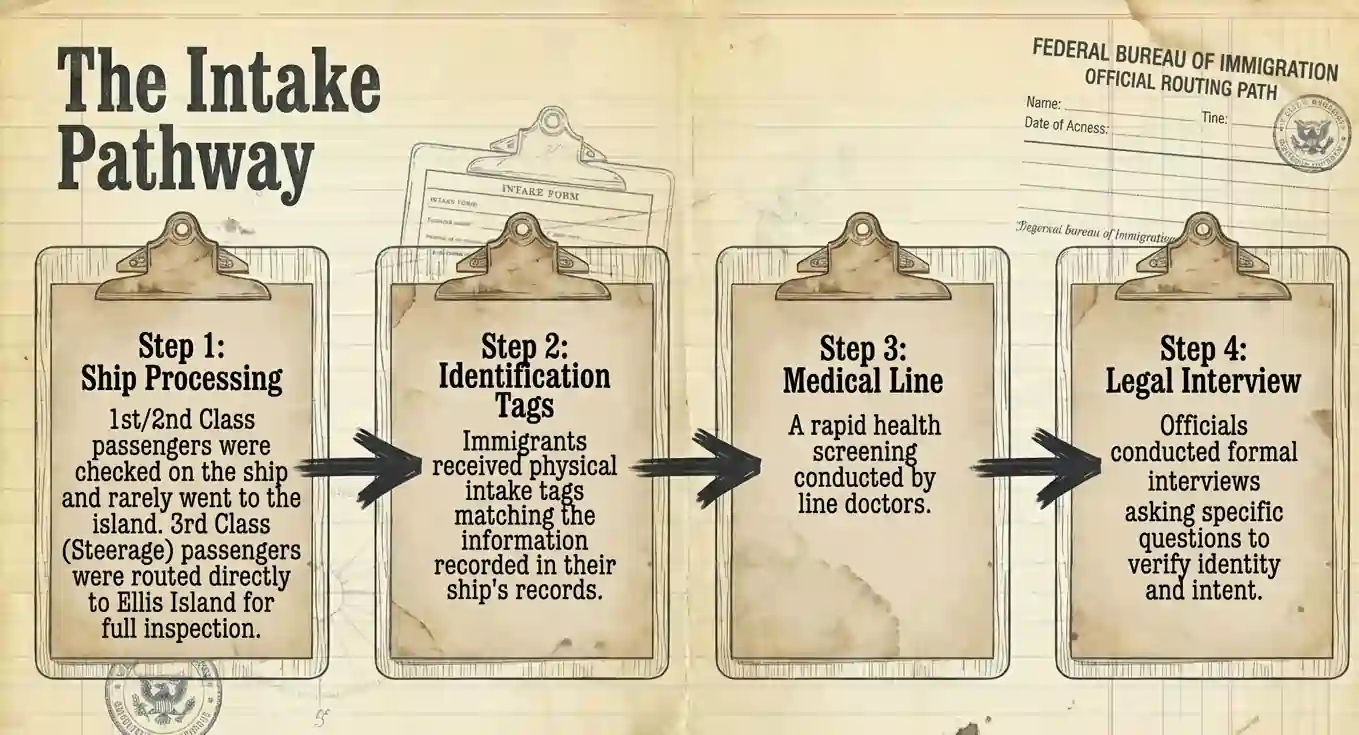
When immigrants arrived, they had to go through a checking process. First, they were given tags that matched the information from their ship records. Then doctors quickly checked their health in what was called a six-second physical. After that, they had legal interviews where officials asked questions about them.
Doctors carefully looked for diseases, especially one called trachoma. They even used a special tool called a buttonhook to check people’s eyes.
There was also an important difference based on how people traveled. People in first and second class were checked on the ship and usually did not need to go to Ellis Island. But people in third class, also called steerage, had to go to Ellis Island for full inspection.
What Happened After the Checks
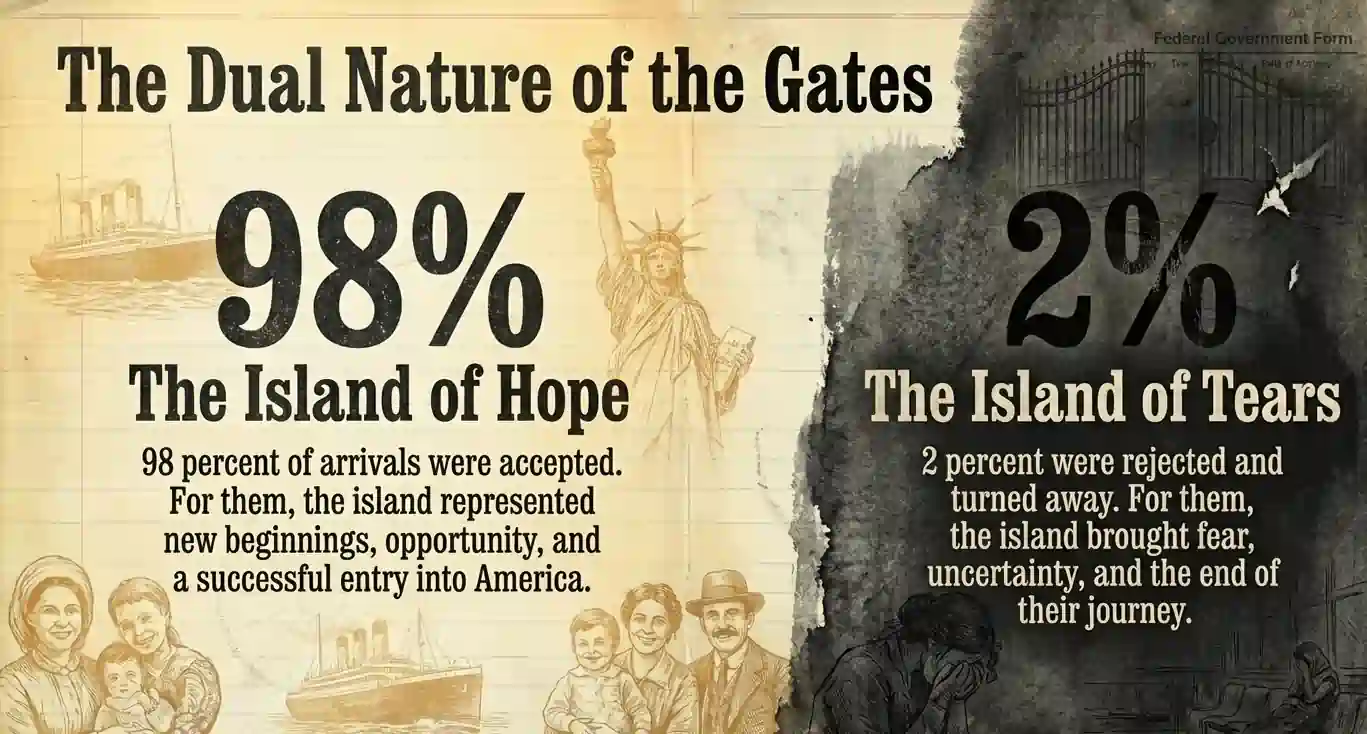
In the end, most people were allowed to enter the country. About 98 percent were accepted, and only 2 percent were rejected. Because of this, Ellis Island was known by two names. It was called the Island of Hope because most people were allowed in, but it was also called the Island of Tears because some people were turned away.
1897-1900: What Happened When Ellis Island Burned and Was Rebuilt
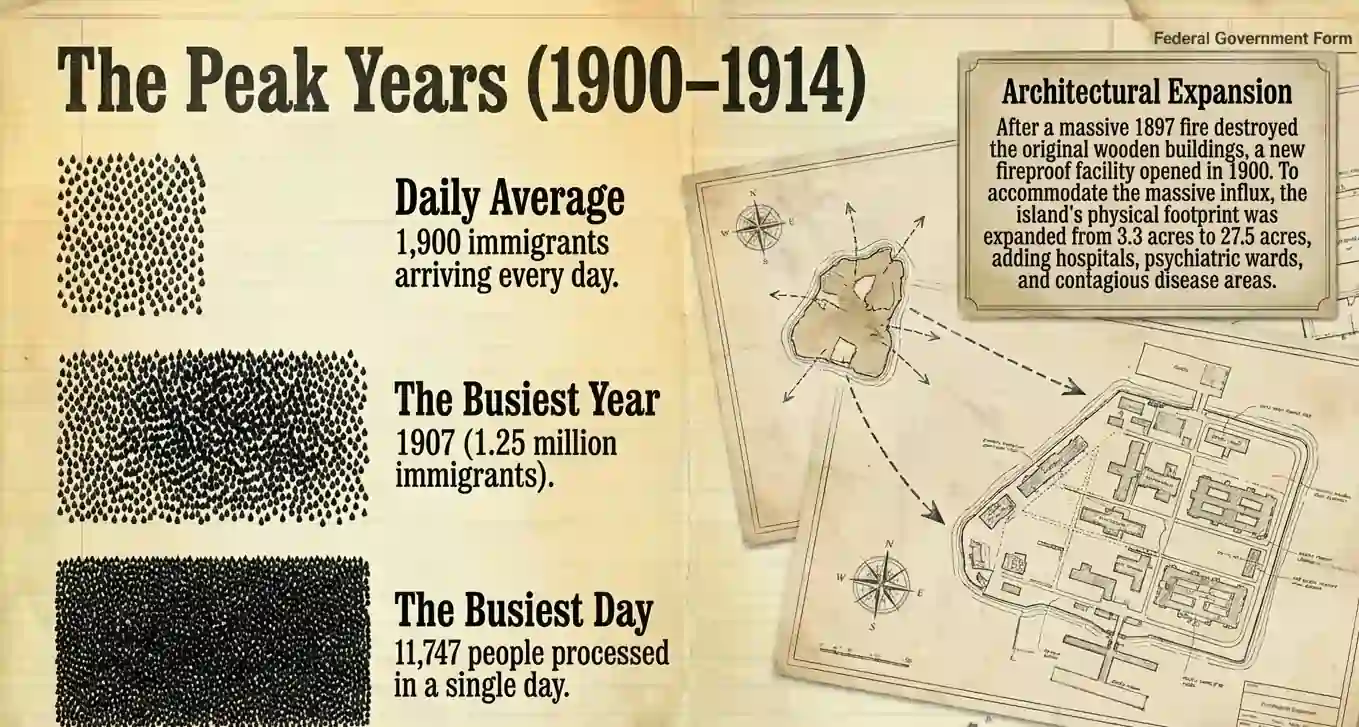
In 1897, a big fire broke out on Ellis Island. The fire destroyed many buildings on the island. It also burned important records from the years 1855 to 1897. After this disaster, a new building was built. In 1900, the new Ellis Island facility opened again. This time, it was built with fireproof materials to help prevent another fire in the future.
1900-1914: When Ellis Island Was the Busiest
From 1900 to 1914, Ellis Island was very busy. During this time, about 1,900 immigrants arrived every day. The year 1907 was the busiest of all, with about 1.25 million immigrants coming in that year. The single busiest day saw 11,747 immigrants processed in just one day.
During these years, the island also became much bigger. It grew to 27.5 acres. New buildings were added, including hospitals, psychiatric wards, and special areas for people with contagious diseases.
1914-1918: What Happened During World War I
From 1914 to 1918, World War I was happening. Because of the war, far fewer immigrants came to Ellis Island. During this time, Ellis Island was used for different purposes. It was used to keep enemy nationals in one place, meaning people from countries that were at war with the United States. It was also used to treat wounded soldiers who were hurt during the war.
1919-1924: Why Immigration Became Strict After the War
From 1919 to 1924, rules about immigration became much stricter. During this time, many immigrants who were seen as radicals were kept at Ellis Island and later sent back to their home countries.
A new rule called a literacy test was also introduced. This meant that immigrants had to show they could read in order to enter the country. There were also new quota laws made in 1921 and 1924. These laws limited how many immigrants were allowed to come into the United States each year.
1924-1954: Why Ellis Island Closed in the End
From 1924 to 1954, Ellis Island slowly stopped being a place where immigrants were processed. Instead, most immigration work was moved to embassies in other countries. Because of this change, Ellis Island took on a new role. It became a detention center where people were held for different reasons.
During World War II, the island was used to detain people from Axis countries. It was also used by the Coast Guard. The last person held at Ellis Island was a man named Arne Petersen in 1954. After that, Ellis Island was officially closed in the same year.
Why Ellis Island Is Important to People Today
Ellis Island is not just a place on the map. It is a very powerful symbol that people remember in different ways. For many immigrants, Ellis Island means hope and a chance for a better life. It reminds them of new beginnings and opportunities.
For people who were kept there as detainees, it brings feelings of fear and uncertainty because they did not know what would happen to them. For some critics, Ellis Island is seen as a symbol of open immigration. Over time, Ellis Island became the main symbol of American immigration, and people often think of it more than any other immigration place.
How Ellis Island Was Different from Other Immigration Places
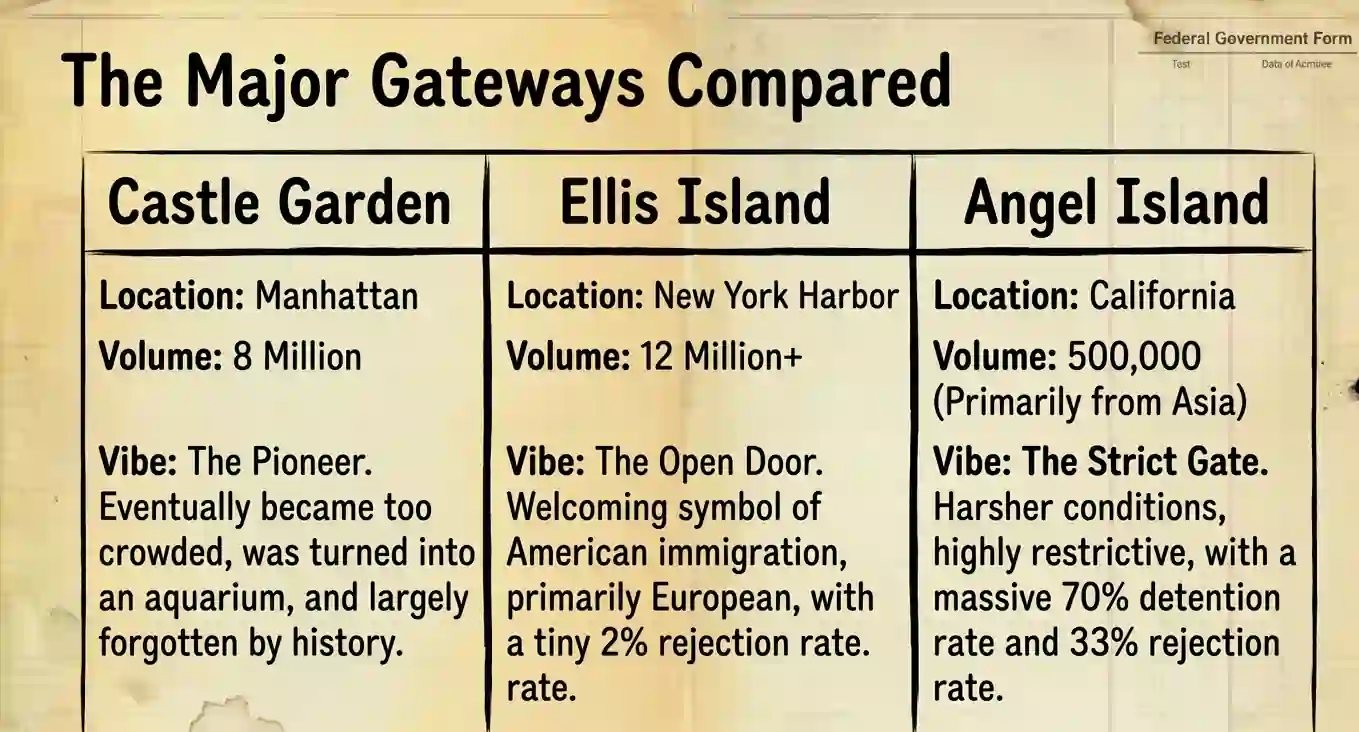
Castle Garden
Castle Garden was one of the first immigration centers in the United States. It processed about 8 million immigrants. Later, it was turned into an aquarium. Because of this, many people slowly forgot about its history and importance.
Angel Island California
Angel Island in California processed about 500,000 immigrants, and most of them were from Asia. The conditions there were much harsher. About 70 percent of people were detained, and around 33 percent were rejected. Because of this, Angel Island was known as a strict and restrictive place, while Ellis Island was known for being more open and welcoming.
1965-1990: How Ellis Island Was Saved and Turned Into a Museum
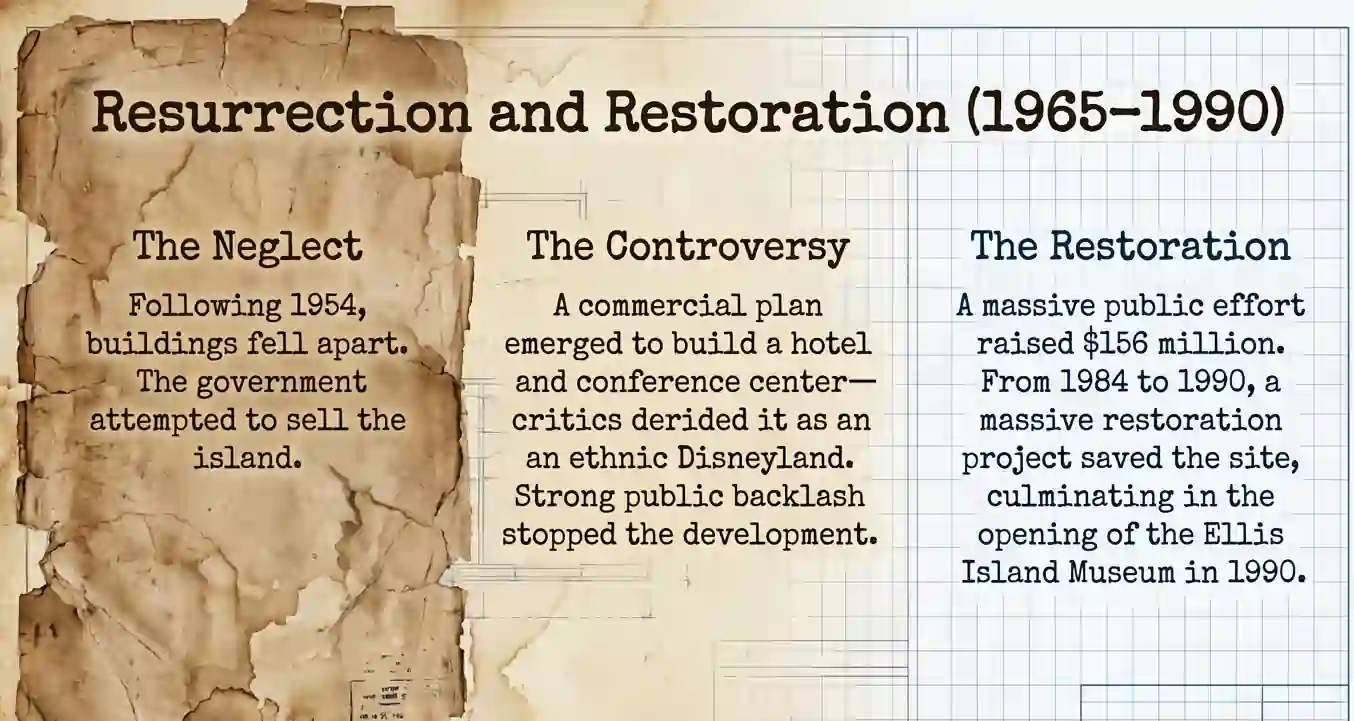
After Ellis Island closed, it was not taken care of for many years. The buildings started to fall apart and became damaged over time. The government even tried to sell the island.
The Controversial Plan
There was a plan to build a hotel and a conference center on the island. Some people called this idea an ethnic Disneyland. Many people did not like this plan, and there was strong public backlash. Because of this, the development was stopped.
Restoring Ellis Island
Later, people worked to save Ellis Island. About 156 million dollars was raised to fix and restore it. A big restoration project took place from 1984 to 1990. After all the work was done, the museum on Ellis Island opened in 1990.
What You Can See at Ellis Island Today
Today, visitors can explore many important parts of Ellis Island and learn about its history.
Main Places to Visit
One of the main areas is the Great Hall, also called the Registry Room. This is where many immigrants were checked when they arrived. Visitors can also see the Wall of Honor. It has more than 775,000 names of immigrants who came to America.
Things You Can See Inside
There are many interesting items to look at, such as suitcases, photographs, and personal stories from immigrants. These help people understand what life was like for those who came to Ellis Island.
Finding Your Family History
Ellis Island also has a large collection of records. There are over 51 million records available. Visitors can use these records to trace their ancestors and learn more about their family history.
What Has Happened to Ellis Island in Recent Years
In 1998, there was a border dispute between New York and New Jersey about Ellis Island.
In 2001, the Immigration History Center was opened so people could learn more and search records.
In 2012, Hurricane Sandy caused damage to Ellis Island.
In 2015, a new area called the Peopling of America Center was opened to share more history.
Ellis Island Today
Today, about 2 million people visit Ellis Island every year. It is also believed that about 33 to 40 percent of Americans have a family history connected to Ellis Island.
Quick Facts About Ellis Island
Ellis Island was active as an immigration station from 1892 to 1954.
During this time, more than 12 million immigrants passed through it.
The busiest year was 1907.
The island also grew in size over time, from 3.3 acres to 27.5 acres.
Common Myths About Ellis Island Explained Simply
Many people think officials changed immigrants' names, but this is mostly false.
No, not everyone passed through Ellis Island.
Ellis Island was not mostly about rejecting people. This is not true. Only 2 percent of immigrants were denied entry.
How to Plan Your Visit to Ellis Island
Ellis Island can be reached by ferry. Many people visit it together with the Statue of Liberty on the same trip. It is a good idea to spend at least 2 to 3 hours there so you can explore everything properly.
Insider Tips for Your Visit
It is best to book your tickets early so you do not miss your chance.
You can use an audio guide to learn more while walking around.
Wear comfortable shoes because you will be walking a lot.
If you want to learn even more, you can try special hospital tours for a deeper history.
Conclusion
Ellis Island is not just a place from history. It is a living symbol of courage, sacrifice, and hope. It tells the story of millions of people who left everything behind to find a better life. When you stand in the Great Hall today, it is hard not to feel the presence of all the people who came before.
Their journeys and stories still feel alive. That is why Ellis Island is still important today. It is not just about history, but also about identity and where people come from.
Frequently Asked Questions
What is Ellis Island, and why is it important in history▾
When did Ellis Island open and close▾
Why was Ellis Island created▾
What happened at Ellis Island in 1897▾
When was Ellis Island the busiest▾
What checks did immigrants go through▾
Why did immigration slow down after 1924▾
What happened after Ellis Island stopped being used▾
How many people passed through Ellis Island▾
What is Ellis Island used for today▾
Sierra
Published on Statue of Liberty Cruises


