Who Is Lady Liberty? Meaning, History & Inspiration Behind the Statue of Liberty
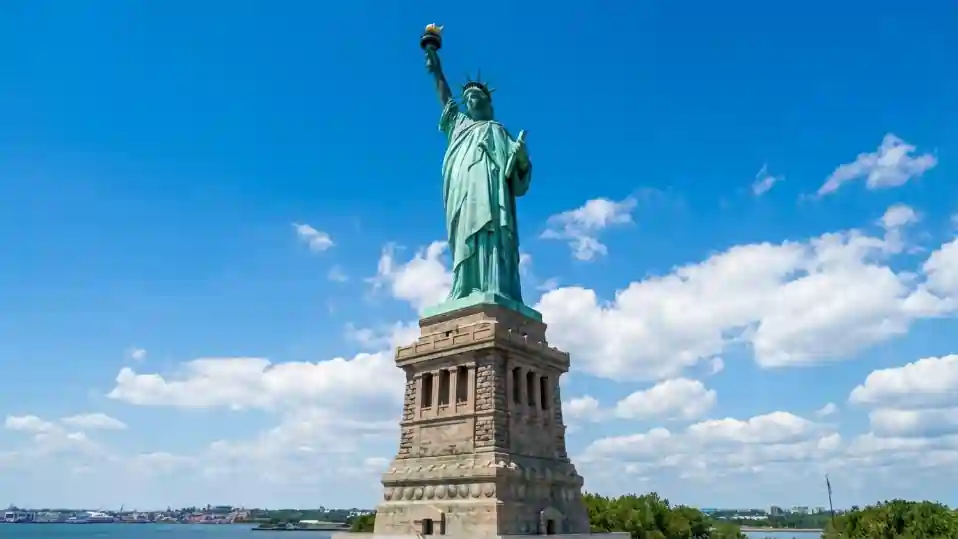
The Statue of Liberty is a very famous statue in the world. Its full name is Liberty Enlightening the World. It stands on Liberty Island in New York. The statue shows a woman. She is holding a torch in her right hand and a tablet in her left hand. This woman is not a real person. She is an idea made to look like a human.
She stands for freedom, hope, and fairness. Many people see her as a kind and welcoming figure.
She greeted millions of people who came to the United States to find a better life. But many people still wonder, who is this woman, and where did her image come from? Let's find out the answers to these questions!
What Was the First Idea of the Statue of Liberty?
Before the Statue of Liberty looked the way it does now, the idea started in a very different place. In 1865, a French historian named Edouard de Laboulaye suggested making a monument. He wanted it to celebrate the friendship between France and the United States and to honor American independence.
Later, a sculptor named Frederic Auguste Bartholdi worked on this idea. He created a design that was inspired by Egypt. His first idea was called Egypt Carrying the Light to Asia. It showed a fallah, which means an Egyptian peasant woman. She was standing at the entrance of the Suez Canal and holding a torch to guide ships.
This idea was inspired by very large ancient statues, like the Colossi of Memnon and the Colossus of Rhodes. These huge statues made Bartholdi think about creating something very big. But this Egyptian project was never built because there was not enough money.
How the Statue of Liberty Design Changed from Egypt to America
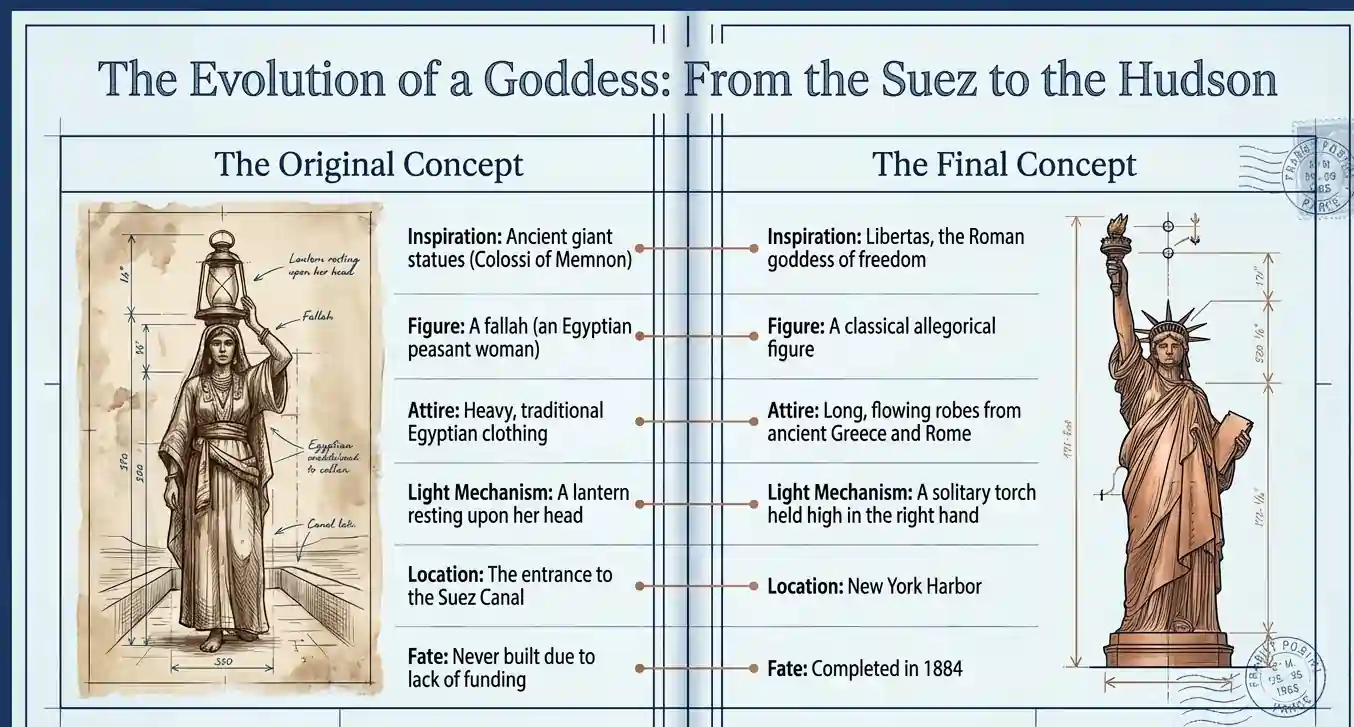
When Bartholdi started working on the idea for the United States, he kept the idea of a woman holding light. But he changed how she looked. The heavy Egyptian clothes were replaced with long, flowing robes inspired by ancient Greece and Rome.
The light, which was first planned to be on her head, was moved to a torch that she holds up high.
A crown with seven rays was added to her head. She also holds a tablet firmly in her left hand. At the statue's feet, there are broken chains and shackles. These show freedom from oppression and the end of slavery.
Who Inspired the Statue of Liberty Design
The final design of the Statue of Liberty was strongly inspired by Libertas, the Roman goddess of liberty. In ancient Rome, Libertas was a symbol of freedom and personal rights.
Like Libertas, the statue wears long robes and carries symbols of independence.
This connection gave the statue a deeper meaning. It connects modern ideas of freedom with ideas from ancient times.
Who Might the Statue of Liberty Face Be Based On
Some historians think that the face of the Statue of Liberty may have been inspired by Bartholdi's mother, Augusta Charlotte Bartholdi. This is not proven, but it suggests that the statue may also have a personal meaning for the artist.
What Does the Statue of Liberty Hold and What Do They Mean
Every part of the statue has a meaning. Each thing she holds or wears tells an important idea.
The Torch in Her Right Hand: The torch in her right hand stands for light. It helps guide people toward freedom and a better future. Inside her arm, there is a narrow service ladder. It is about 42 feet or 12.8 meters long and leads up to the torch. People could climb this ladder from 1886 until 1916. After that, it was closed for safety.
The Tablet in Her Left Hand: The tablet in her left hand has the words JULY IV MDCCLXXVI written on it. This date marks when the Declaration of Independence was adopted.
The Crown on Her Head: The crown has seven rays. These rays stand for the seven continents and the seven seas. This means that liberty belongs to the whole world.
The Chains and Shackles at Her Feet: At her feet, there are broken chains and shackles. These show freedom from oppression and the end of slavery.
How Was the Statue of Liberty Built?
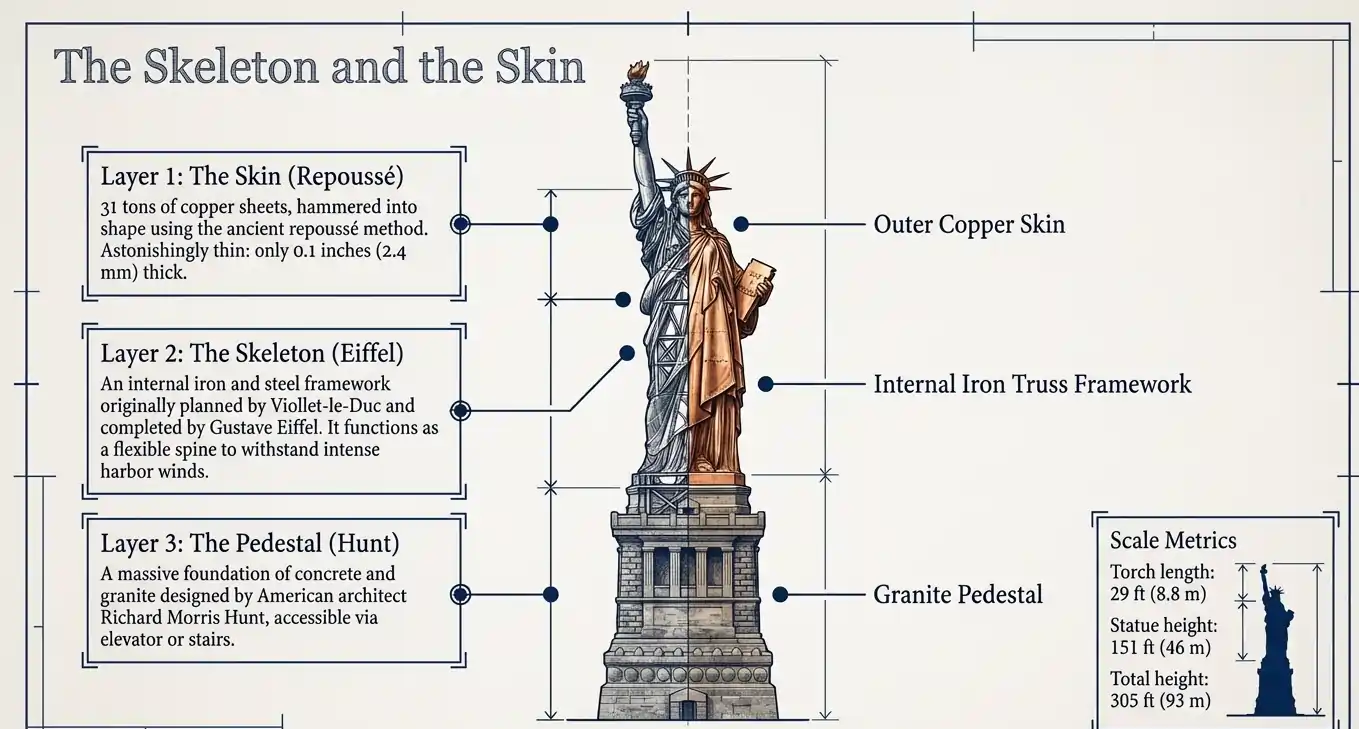
The statue was built in France between 1875 and 1884 under Bartholdi's direction. Workers used an old method called repousse. They hammered about 31 tons of copper sheets into shape. Each sheet was very thin, only 0.1 inches or 2.4 mm thick.
These copper sheets were placed on a strong frame made of iron and steel. The inside structure was first planned by Eugene-Emmanuel Viollet-le-Duc. Later, it was completed by engineer Alexandre Gustave Eiffel.
His design worked like a skeleton and helped the statue stay strong against wind and weather.
Size and Structure Details
The base, called the pedestal, was made of concrete and granite. It was designed by an American architect named Richard Morris Hunt. The statue alone is over 151 feet or 46 meters tall.
With the pedestal, the total height is 305 feet or 93 meters. The torch by itself is about 29 feet or 8.8 meters long. Visitors can go up to the pedestal using an elevator or stairs. From there, a spiral staircase goes up to the crown.
Color Change Over Time
Over time, the copper surface changed from brown to green. This happened because of natural weather. The green layer is called patina. It helps protect the metal from damage.
How Did the Statue of Liberty Travel to America
After it was finished, the statue was given to the United States in Paris on July 4, 1884. Then it was carefully taken apart into 350 pieces and packed into 214 wooden crates.
These crates were sent across the Atlantic Ocean on a French ship named Isere.
The journey took almost one month. The statue reached New York Harbor in June 1885 and was put back together on Liberty Island. On October 28, 1886, President Grover Cleveland officially dedicated the statue.
Who Helped Build the Statue of Liberty
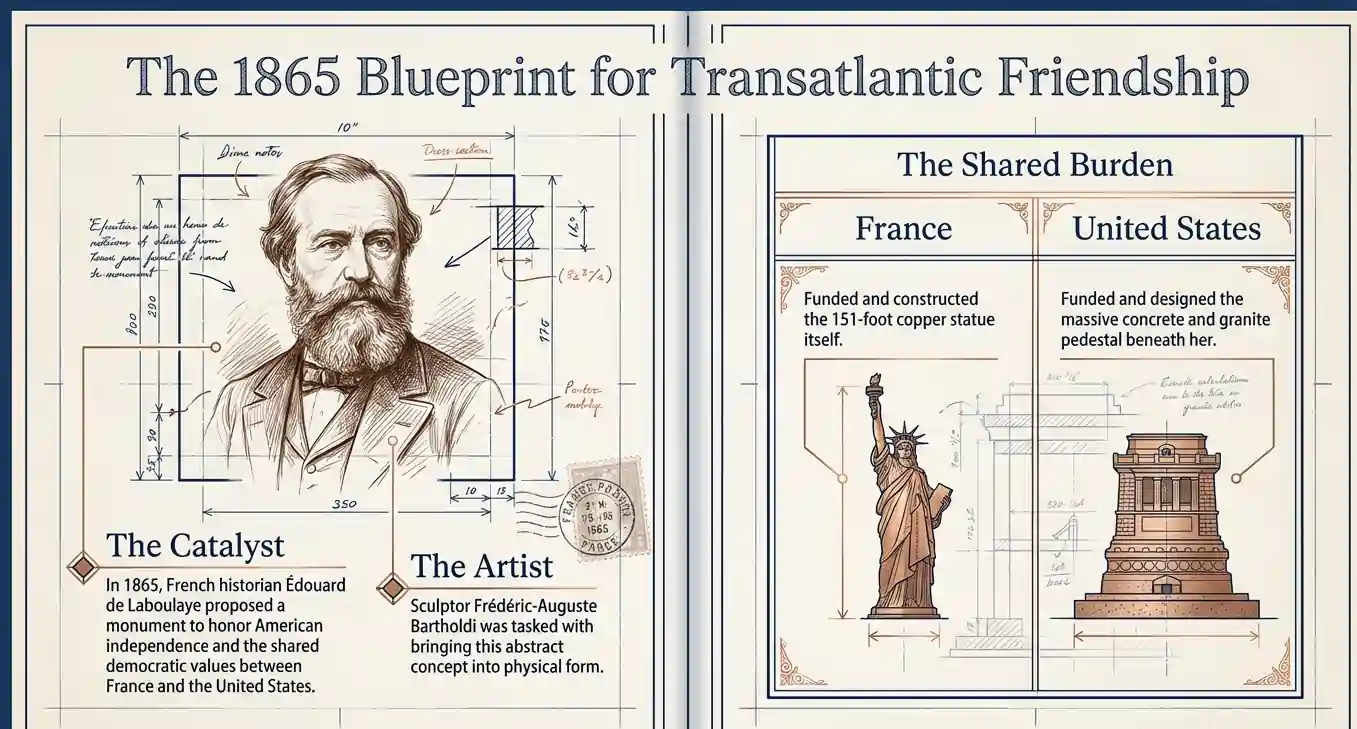
The Statue of Liberty was a project done together by France and the United States. The people of France paid for the statue itself, and Americans paid for the pedestal.
The idea for the statue was first suggested by Edouard de Laboulaye.
It was meant to celebrate American independence and the shared values of liberty and democracy between France and the United States.
What Was Ellis Island and Why Is It Important?
Ellis Island is near the Statue of Liberty. It used to be the main place where immigrants came to the United States. Between 1892 and 1924, about 12 million immigrants passed through this island.
Life at Ellis Island
Most immigrants were checked in a large hall. The inspections usually took three to five hours. In 1897, a fire destroyed the first wooden buildings and all the official records.
The buildings were later rebuilt with fireproof materials. A new main building opened in 1900.
After 1943, Ellis Island stopped being an immigration center.
It was used as a detention station for immigrants and people who were sent back to their countries until 1954. The island opened for visitors in 1976, and in 1990, it became the Ellis Island Immigration Museum.
The Statue of Liberty as a Symbol
For many people coming by sea, the Statue of Liberty was the first thing they saw in America. It became a strong symbol of hope and a fresh start for a new life.
What Is The Poem Inside the Statue of Liberty
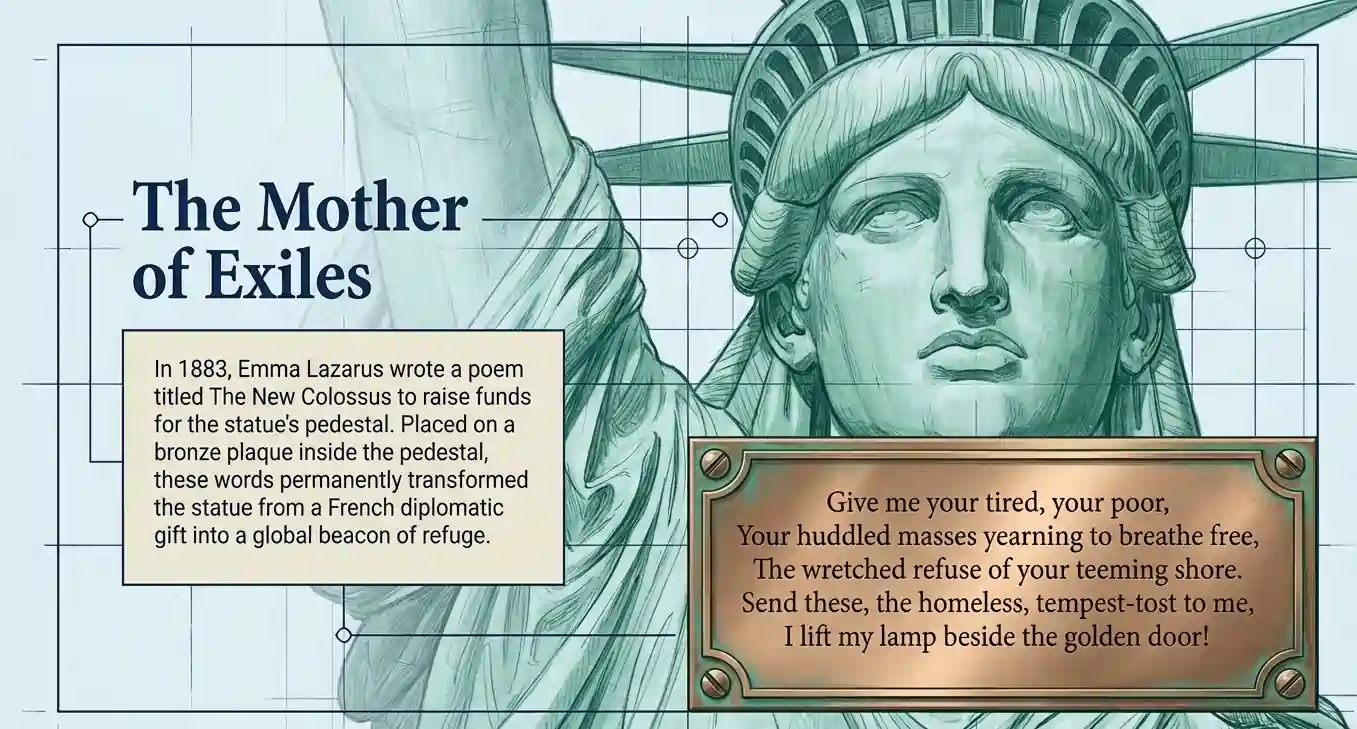
Inside the pedestal of the Statue of Liberty, there is a bronze plaque with a poem called "The New Colossus." It was written in 1883 by Emma Lazarus. The poem was made to help raise money for the pedestal and gave the statue a deeper human meaning.
What the Poem Says
The poem shows the statue as a welcoming figure, not a giant who destroys people. Its famous lines say:
“Give me your tired, your poor,
Your huddled masses yearning to breathe free,
The wretched refuse of your teeming shore.
Send these, the homeless, tempest-tost to me,
I lift my lamp beside the golden door!”
Why the Poem Is Important
Because of this poem, the statue became known as the Mother of Exiles. It shows hope and welcome for people coming from all over the world.
How the Statue of Liberty Changed and Was Restored
Over the years, the Statue of Liberty has been carefully looked after and restored. The torch was changed several times. In 1916, it was changed to use electric power.
During restoration work in the 1980s, the torch was redesigned with copper covered in gold leaf.
The original torch from 1886 was removed later. In 2018, it was put inside the Statue of Liberty Museum. Visitors can still see it there today.
Who Took Care of the Statue
The statue was managed by different groups over time. These included the U.S. Lighthouse Board, the War Department, and later the National Park Service.
The Statue of Liberty became a national monument in 1924. Later, in 1984, it was recognized as a UNESCO World Heritage Site, which means it is important and protected for the whole world.
Conclusion
Lady Liberty is not one real woman. She is a portrait of many ideas and inspirations. She was inspired by an Egyptian peasant, a Roman goddess, and a possible mother’s face, and she also became a symbol of freedom for everyone.
She is not just a statue. She sends a message that has stayed strong over time. Standing in the harbor, she still welcomes people and reminds the world about hope, opportunity, and the lasting meaning of liberty.
Frequently Asked Questions
Who was the real woman behind the Statue of Liberty?▾
Did the Statue of Liberty have a real-life model?▾
Who designed the Statue of Liberty?▾
Why is the statue called Lady Liberty?▾
When was the Statue of Liberty built?▾
Was the Statue of Liberty meant to honor a woman?▾
What inspired the idea of the Statue of Liberty?▾
Who helped Bartholdi create the statue?▾
What does Lady Liberty hold and why?▾
Why is the statue important today?▾
Sierra
Published on Statue of Liberty Cruises


